
Dot and dab is one of the quickest ways to get straight, smooth walls on brick or block. Instead of plastering the wall itself, plasterboard is stuck to it with blobs of adhesive, then skimmed. Here’s how it works, when it’s the right choice, and when a different method makes more sense.
What is dot and dab?
Dot and dab (also called drylining with adhesive) means fixing plasterboard directly to a masonry wall with dabs of gypsum-based adhesive. The boards are pressed onto the dabs and tapped back with a long straight edge until they’re flat and plumb. The small gap the dabs leave behind the board lets it sit straight even when the wall underneath isn’t.
Once the boards are up, the joints are taped and the wall is usually skimmed with finishing plaster, so it looks and decorates just like a plastered wall.
When dot and dab is a good choice
- New block walls in extensions and new builds, where a fast, dry finish keeps the job moving.
- Uneven older brick walls that would need very thick plaster to bring them flat.
- Walls stripped back during a renovation, where the old plaster has come off and needs replacing.
- Jobs where time matters. There’s far less water in the wall than with a backing coat, so it’s ready to decorate sooner.
When it isn’t
- Damp walls. The cause of the damp has to be fixed first. Plasterboard won’t cure it.
- Loose, crumbling or heavily painted surfaces, unless they’re prepared properly first, because the adhesive needs something sound to grip.
- Rooms where every centimetre counts. Board plus adhesive takes up a little more space than plaster alone.
- Walls that will carry lots of heavy fixings, unless those are planned for at the boarding stage.
For timber or metal stud walls, ceilings and badly out-of-true walls, boards are screwed to studs or battens instead. Our dry lining and plasterboarding page covers the different methods.
How a wall is dot and dabbed
- Preparation. The wall is cleaned of dust and loose material. Very absorbent surfaces may be primed so the adhesive doesn’t dry out too fast.
- Setting out. Lines are marked so every board finishes plumb and in line, with cut-outs planned for sockets, switches and windows.
- Adhesive. Dabs go on in vertical rows, with a continuous band around the edges of the wall, openings and sockets, following the board and adhesive manufacturer’s guidance.
- Boarding. Each board is pressed on, then tapped back with a straight edge until it’s flat and in line with its neighbours.
- Finishing. Once the adhesive has set, the joints are taped and the wall is skimmed, ready to decorate when it’s dry.
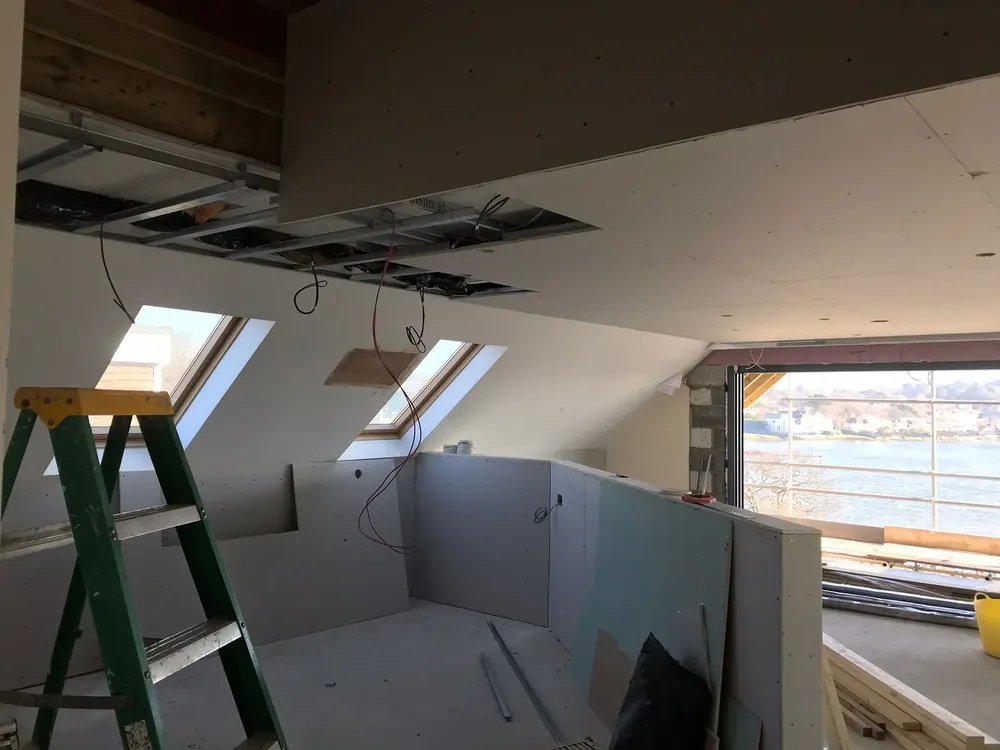
Dot and dab vs wet plastering
| Method | Best for | Things to know |
|---|---|---|
| Dot and dab | Uneven or new masonry, fast-moving jobs | Quick to dry, as only the skim holds water. Plan heavy fixings; takes a little room space. |
| Wet plastering | Solid walls, older homes, rooms with heavy fixings | Slower to dry, as the backing coat holds lots of water. Solid feel; very uneven walls need thick coats. |
| Boards on studs or battens | Stud walls, ceilings, badly uneven walls | Quick to dry, as only the skim holds water. Room for insulation; takes more space. |
Hanging things on a dot and dab wall
Light things such as pictures and mirrors can go on plasterboard fixings. For anything heavy, like a TV bracket, shelves or kitchen wall units, fix through the board into the masonry behind with fixings long enough to reach it. If you know where heavy items will go, tell your plasterer before boarding so extra adhesive can go behind those spots.
Need walls boarded and skimmed?
Four Four Finishes dry lines and plasters walls in extensions, loft conversions and older homes across Poole, Bournemouth and the rest of Dorset. We’ll look at your walls and tell you whether dot and dab, battens or wet plastering will give the best result. See our dry lining and skimming pages for more.
Frequently asked questions
Is dot and dab better than plastering?
Neither is better everywhere. Dot and dab is quicker, uses far less water and is good at straightening uneven masonry. Wet plastering gives a solid wall that sounds and feels solid, takes heavy fixings anywhere and loses no space. The wall and the job decide which suits.
How soon can dot and dab boards be skimmed?
The adhesive sets much faster than a backing coat of plaster dries, so boards can often be skimmed within a day or so. The exact time depends on the adhesive, the temperature and how thick the dabs are, so always follow the manufacturer’s guidance.
Can you hang a TV or kitchen cupboards on a dot and dab wall?
Yes, with the right fixings. Heavy items should be fixed through the board into the masonry behind, ideally where extra adhesive was planned at the boarding stage. Light items such as pictures can go on suitable plasterboard fixings.
Can you dot and dab onto a damp wall?
No. Damp needs to be found and fixed first, because the adhesive won’t bond properly to a wet wall and the board can be damaged. Plasterboard is not a cure for damp.
Does dot and dab plasterboard need skimming?
Square-edged boards are skimmed with finishing plaster to give a smooth, hard surface. Tapered-edge boards can instead have their joints taped and filled, but a skim gives a tougher finish that hides joints completely.